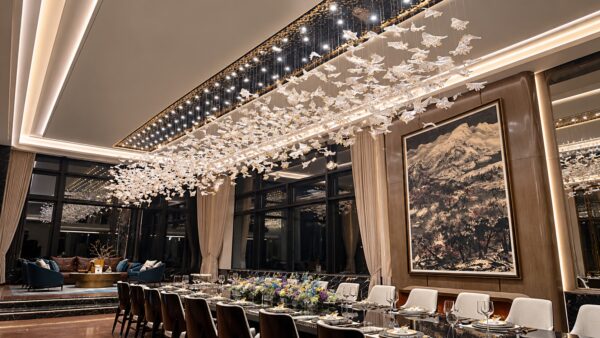
You step into a dining room. Before you notice the table or the artwork, your eyes rise to the chandelier. That pull happens before you think about it.
A custom crystal chandelier becomes the visual focal point of a dining room through three forces working together. Lighting shape sets the mood. Spatial proportion anchors the fixture to the table and ceiling. Visual layering adds depth and sparkle. Tikanna’s custom manufacturing brings all three together in one made-to-measure piece.
Tikanna tailors size, silhouette, and materials to your specific room. The result feels intentional, not purchased off a showroom floor. Each force builds on the others.
Key Takeaways
- A custom crystal chandelier becomes the visual focal point through lighting shape, spatial proportion, and visual layering.
- Scale, silhouette, and contrast work together to make the chandelier stand out and anchor the room.
- Proper sizing and hanging height tie the chandelier to the table and ceiling for a balanced look.
- Layering crystals and metals adds depth and sparkle, making the chandelier a stunning centerpiece.
- Tikanna’s custom manufacturing tailors size, shape, and materials to your exact space and style.
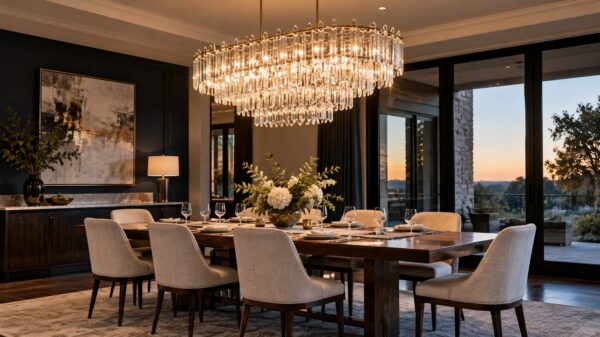
What Makes a Custom Crystal Chandelier the Visual Focal Point
Scale, Silhouette, and Contrast
A focal point does not happen by accident. It earns attention through three qualities working together.
To act as a visual anchor, a fixture needs to possess three specific qualities: scale, silhouette, and contrast. If a light is too small, it disappears. If it’s too busy, it creates visual clutter. The goal is balanced impact.
Scale means sizing with intention. You can apply a simple formula: chandelier diameter in inches equals room length plus width in feet. A 12 by 14 foot dining room needs a 26-inch minimum. When you feel uncertain, size up. Undersized fixtures vanish. Oversized ones become the statement piece you want.
Silhouette gives the fixture drama. The most successful focal point chandeliers have sculptural presence. Think sculptural branches, globe clusters, tiered crystal, geometric frames, or linear suspensions. Generic shapes fade into the background. Choose forms with visual interest from every angle. The fixture should read as modern art hanging from the ceiling.
Contrast sets the chandelier apart from its surroundings. Black against a white ceiling, brass against a navy ceiling, or crystal against neutral walls all create high contrast. This distinction ensures the fixture registers as the focal point rather than blending into the architecture.
Crystal adds a special advantage. Its shimmering surface bounces light around the room. This bouncing light creates an illusion of airiness. The fixture feels lighter than its actual weight. The room feels more open and bright.
Why the Dining Room Needs a Centerpiece
The dining room is a gathering space. People come together there for meals, conversation, and connection. A centerpiece anchors that experience.
Vivian Torres, Lead Designer at Havenly, notes that fresh plants or flowers make the dining table feel “pretty and put together.” Elongated branches help “make more of a statement.” Kelsey Fischer, also a Lead Designer, adds that a pretty centerpiece when the table isn’t in use helps “add an element of style and fun.”
A chandelier performs this role on a grander scale. It does two jobs at once. It provides necessary light. It also signals what kind of space the room wants to be: formal, relaxed-but-polished, or traditional-with-fresh-edges. This makes it the hinge point of a room’s design.
Over a solid wood dining table, the chandelier creates a pool of light that draws people together. It gives the room an emotional center and a place for the eye to rest. In open-concept layouts, a chandelier acts as a visual anchor. It divides and defines functional areas without physical walls. The space stays airy yet connected.
Designers call chandeliers the “jewelry of a home.” They define a room’s personality. A well-chosen fixture does not fight the dining table. It completes the sentence the furniture has already started. The right custom crystal chandelier reinforces the room’s design identity. It makes ordinary dining feel like a special occasion.
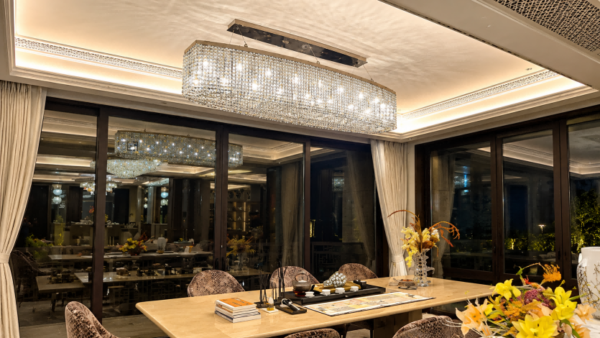
Spatial Proportion and the Dining Room Anchor
Sizing to Table and Ceiling
Spatial proportion determines whether your chandelier feels like it belongs in the room. Get the size wrong, and even a beautiful fixture looks out of place. Get it right, and the chandelier becomes the focal point you envisioned.
Start with the table. Your chandelier diameter should measure between one-half and two-thirds the width of your dining table. A 60-inch table pairs well with a 30 to 40 inch chandelier. For linear fixtures, apply the same ratio to the table length. An 84-inch table suits a fixture in the 42 to 56 inch range.
Room dimensions matter when you have no table yet. Add the room’s length and width in feet. Convert that total to inches. A 12 by 14 foot room suggests at least a 26-inch chandelier. Small rooms under 100 square feet need a diameter of 20 inches or less. Large rooms over 500 square feet can handle a more sizable fixture.
Hanging height ties the chandelier to the table below. The lowest point of the fixture should hang 30 to 34 inches above the tabletop. With ceilings taller than 8 feet, raise the fixture about 3 inches for each additional foot of ceiling height.
| Factor | Guideline |
| Diameter relative to table width | One-half to two-thirds the table width |
| Hanging height above tabletop | 30-34 inches |
| Ceiling height adjustment | Add 3 inches per foot above 8 feet |
| Small rooms (under 100 sq ft) | 20 inches or less in diameter |
The restaurant case study shows how an elongated sculptural chandelier above a long dining table reinforces the layout better than a conventional circular fixture. The suspended composition extends along the dining area. This creates a stronger relationship between the fixture and the furniture beneath it. Suspension height and visual density must harmonize with surrounding architecture. The fixture becomes part of the architectural experience rather than an isolated decorative object.
Symmetry, Alignment, and Balance
Centering your chandelier over the dining table is essential. Center it over the table, not the room, even if the table is not perfectly centered in the space. When a fixture is centered on the room instead of the table, the misalignment is subtle but noticeable. The space feels unresolved even if all other elements are correct.
Proper height placement keeps the light visually tied to the table. This establishes a clear focal point and makes the room feel grounded and cohesive. This alignment is especially important in open-concept layouts and spaces that are not perfectly symmetrical.
For long rectangular tables or open-concept dining spaces, using several chandeliers or pendant lights provides adequate lighting coverage while adding sophistication. In a large formal dining room, center two chandeliers over one table for symmetry. For tables seating eight or more people, a linear chandelier or a pair of smaller chandeliers often creates better balance than one oversized fixture.
A chandelier that is too large overpowers the space. One that is too small feels insignificant. Both disrupt the radial balance and visual stability centered on the dining table. When deciding between two sizes, lean toward the larger option. A slightly larger chandelier tends to feel intentional. A too-small one can get lost over a long table.
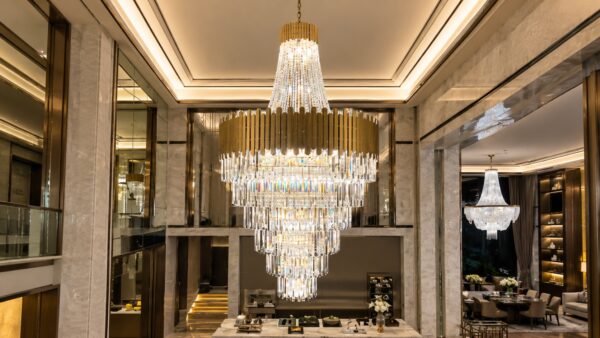
Visual Layering Through Crystals and Metals
Tikanna’s Custom Material Combinations
Tikanna combines crystals, metals, and finishes to build layered depth and a beautiful play of light. The metal framework and the crystal elements each play distinct roles. In contemporary designs, simple metal lines and curves form a sophisticated silhouette. Layered tiers of dazzling crystal sit against those clean lines. This pairing creates provocative, dimensional forms. In artistic castings, casted metal structures act as frames. Glimmering crystals accent each piece. The metal framework encloses and highlights the crystal accents. This produces regal visual depth.
You can see this principle in the restaurant case study. The chandelier features numerous suspended decorative elements arranged in a flowing composition. These layered components create movement and visual interest from multiple angles. The illuminated details draw attention without obscuring the surrounding interior. The fixture becomes part of the architectural experience.
Depth, Sparkle, and Dimension
Tiered or horizontally stacked layers create a wide, structured silhouette. Stacked layers build visible height. They draw your eye upward and link lower and upper levels in two-story spaces. Tapered or elongated tiered designs balance narrow or very tall rooms better than wide crystal bodies.
Crystal scatters and reflects light strongly. It produces more sparkle and light play than standard glass. It often looks brighter, sharper, and more reflective under the same bulb setup. It remains decorative even when switched off.
A focal point chandelier needs supporting ambient lighting to read as deliberate emphasis. Recessed downlights, wall sconces, and table lamps form the ambient base layer. The chandelier becomes the dramatic accent layer above. Without this supporting layered lighting, the chandelier reads as harsh isolated brightness. All fixtures should be on dimmers with separate switches for flexibility. This approach makes your custom crystal chandelier focal point effect feel intentional and balanced.
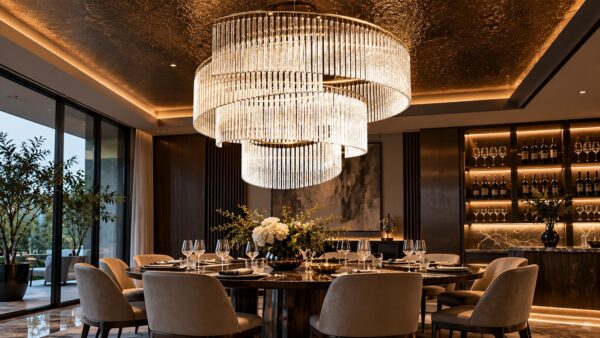
Lighting Shape and Tikanna’s Custom Manufacturing
How Shape Sets Mood and Style
Shape transforms light into texture and atmosphere. A sculptural chandelier with cascading glass pendants creates an organic, fluid light texture. A tiered crystal composition multiplies light scatter for brilliance suited to long dining tables. The silhouette you choose determines whether your fixture reads as modern art or traditional elegance.
| Chandelier Shape | Influence on Mood and Style |
| Round or organic | Best for round tables; creates harmonious, eclectic feel |
| Linear or rectangular | Mirrors long tables; offers sleek, modern look |
| Grouped or paired | Establishes chic contrast and symmetry |
| Oversized traditional | Conveys fullness and impact with simple silhouette |
| Mixed pendants | Creates interesting, non-uniform display for open spaces |
| Candelabra-style | Evokes traditional, romantic formality |
| Minimalist pendants | Delivers subtle balance and understated chic |
| Sputnik | Iconic art deco, otherworldly design |
A genuine focal point chandelier needs a clear silhouette that reads strongly even when unlit. Generic drum shades rarely achieve this. Sculptural forms with distinctive materials or bold finishes give your fixture visible authority. This is how a custom crystal chandelier becomes the visual focal point of a dining room.
Tailoring Size, Shape, and Materials
Tikanna’s custom process starts with project consultation. You share your brief, and the team discusses vision and requirements in detail. For ODM projects, Tikanna provides free 2D and 3D drawings until you finalize the design. A detailed quote follows, covering pricing and timeline. After you approve all specifications, sampling and prototyping begin. Manufacturing happens in-house with integrated quality control. Pre-shipment inspection photos or video reports come to you before shipping.
Tikanna tailors dimensions, metal finishes, glass colors, and voltage wiring to your space. Brass and copper provide warm, classic elegance. Stainless steel and aluminum offer sleek, contemporary looks. Hand-cut crystal adds brilliance for focal points. Tikanna serves hotels, restaurants, villas, and commercial interiors through OEM and ODM services.
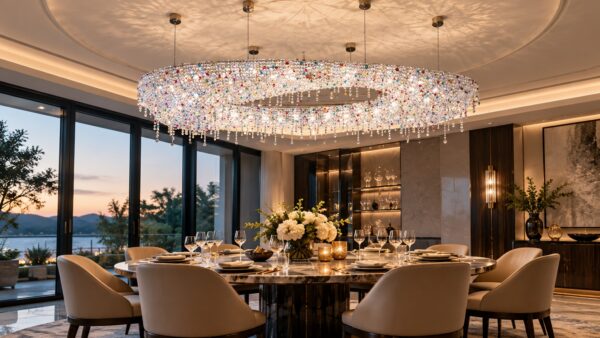
Lighting shape, spatial proportion, and visual layering work as one system. Shape sets the mood. Proportion ties the fixture to your table and ceiling. Layering adds depth and sparkle. Together, they make a custom crystal chandelier a focal point that feels intentional from every seat.
Tikanna turns these principles into a made-to-measure reality. You avoid the off-the-shelf compromise. Instead, you get a fixture built around your room’s exact dimensions, finishes, and light needs.
Picture your own dining room transformed. Send Tikanna your renderings, CAD drawings, or reference images. The team will help you design a chandelier made for your space.
FAQ
How do I choose the right chandelier size for my dining room?
Measure your table width first. Your chandelier diameter should measure between one-half and two-thirds of that width. For a 60-inch table, choose a fixture between 30 and 40 inches. You can also add your room’s length and width in feet to get a minimum diameter in inches.
What hanging height works best above a dining table?
Hang the lowest point of your chandelier 30 to 34 inches above the tabletop. If your ceiling exceeds 8 feet, raise the fixture about 3 inches for each additional foot.
Can Tikanna match my chandelier to my existing metal finishes?
Yes. Tikanna tailors metal finishes to your space. Brass and copper deliver warm, classic elegance. Stainless steel and aluminum create sleek, contemporary looks. You share your vision, and the team coordinates finishes with your interior.
What information should I send Tikanna to start a custom project?
Send renderings, CAD drawings, or reference images. Include your ceiling dimensions, desired fixture size, material preferences, and lighting requirements. Tikanna provides free 2D and 3D drawings for ODM projects until you finalize the design.
How does a linear chandelier differ from a round one for long tables?
A linear chandelier mirrors the shape of a long dining table. It extends along the seating area and creates balanced light coverage. A round fixture concentrates light in one spot. For tables seating eight or more, a linear design or paired fixtures often works better.